GOSHEN POLICE BOOTH
The Goshen Police Booth
A Downtown Landmark of Safety, Communication, and Civic Pride
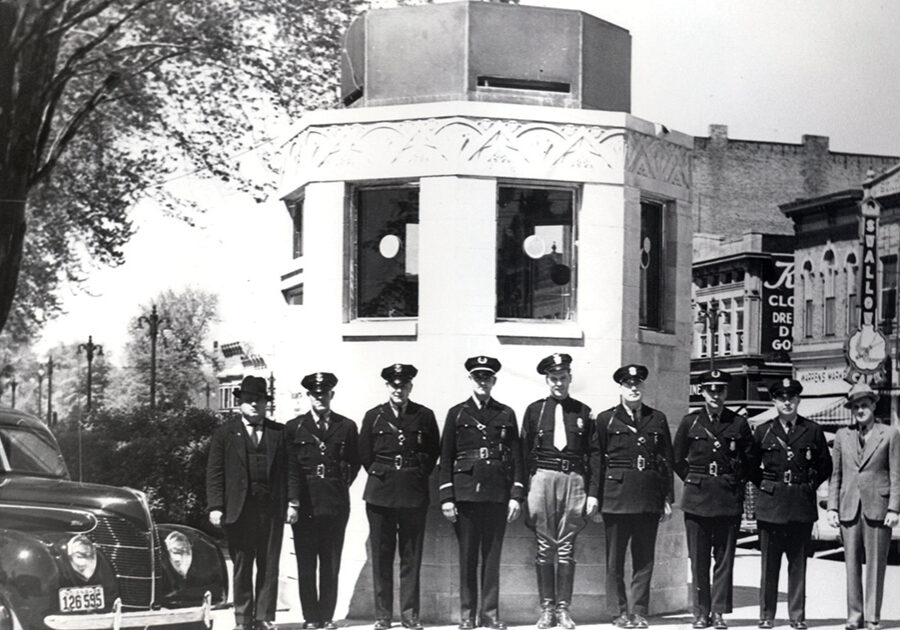
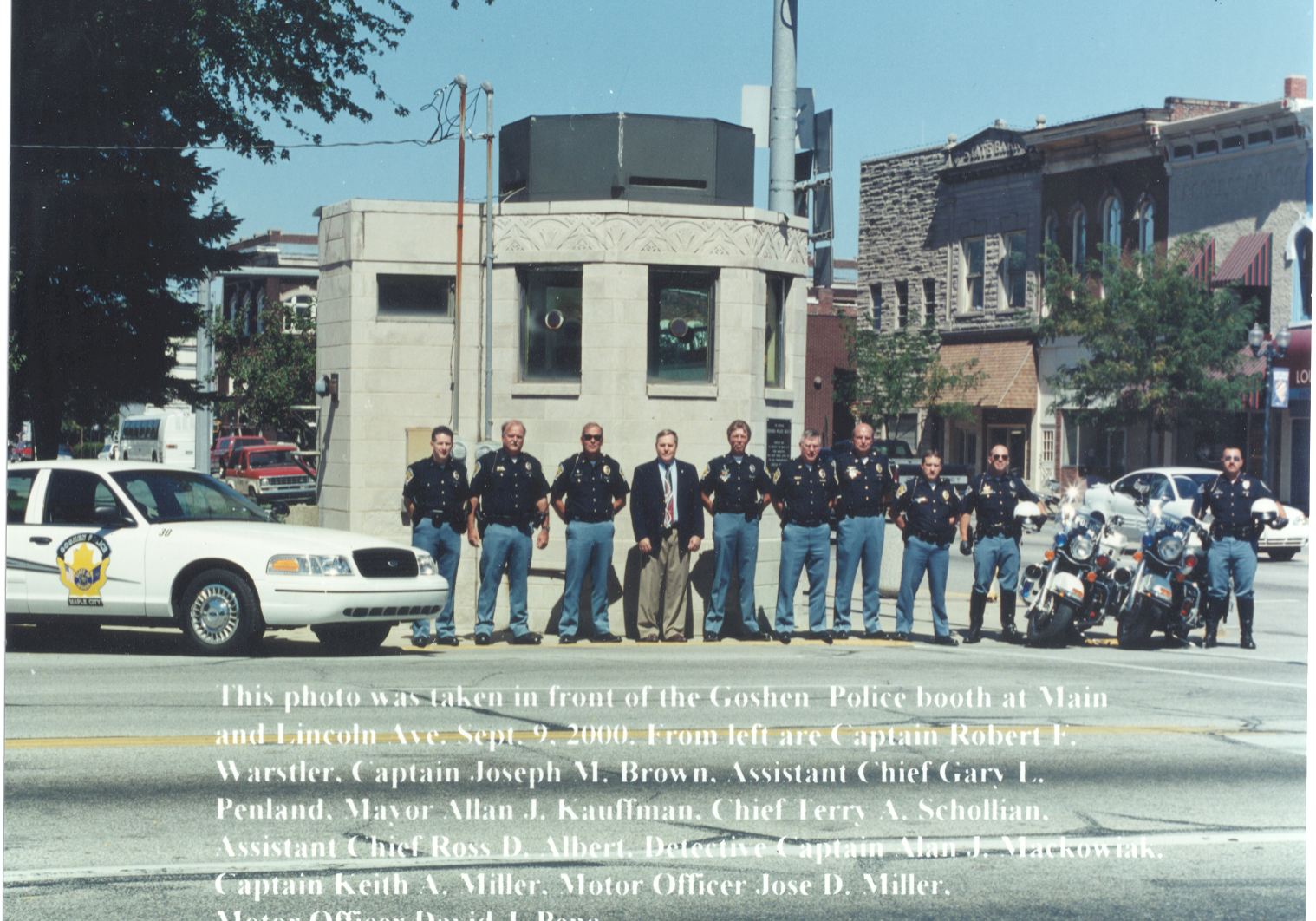
Standing at the northwest corner of Main Street and Lincoln Avenue, the Goshen Police Booth is one of the city’s most recognizable and unique historic structures. More than a novelty, the booth represents a critical chapter in Goshen’s public safety history—one shaped by the Great Depression, New Deal programs, local industry, and a community-wide commitment to order and accessibility.
Origins in the WPA Era
In the late 1930s, communities across the nation were reshaping public infrastructure through the federal Works Progress Administration (WPA). Goshen joined this movement in late 1938, when the city received approval for $1,794 in WPA funding to construct what was officially described as a “municipal police control station.” The city itself contributed an additional $1,500, while the City of Bedford, Indiana, donated the limestone used for the exterior—an early example of regional cooperation during hard economic times.
A December 6, 1938 article in the News-Democrat reported the approval, noting that construction would begin immediately using WPA labor. Work commenced within a temporary wooden enclosure, allowing the booth to take shape during winter months.
Community-Built: Local Contributions
The Police Booth was not only a federal project—it was a truly local one. Numerous Goshen businesses and institutions contributed materials and expertise:
- Salem Bank & Trust Company and First National Bank donated the two-inch-thick bulletproof glass windows, reinforcing the booth’s role as a place of security.
- Penn Electric Switch Company supplied the heating and ventilation controls.
- Hettrick Manufacturing Company and Manrow Sheet Metal Company contributed additional components.
This collective effort reflected Goshen’s strong industrial base and civic pride during the Depression era.
Design and Construction
The completed structure was octagonal in shape, a design chosen for visibility in all directions at one of downtown’s busiest intersections. The exterior walls were built of limestone and glass, while the interior featured three-ply veneer paneling. Above, a small turret tower roof clad in copper sheeting gave the booth a distinctive profile that still draws attention today.
Inside, the booth was designed for long hours of continuous use:
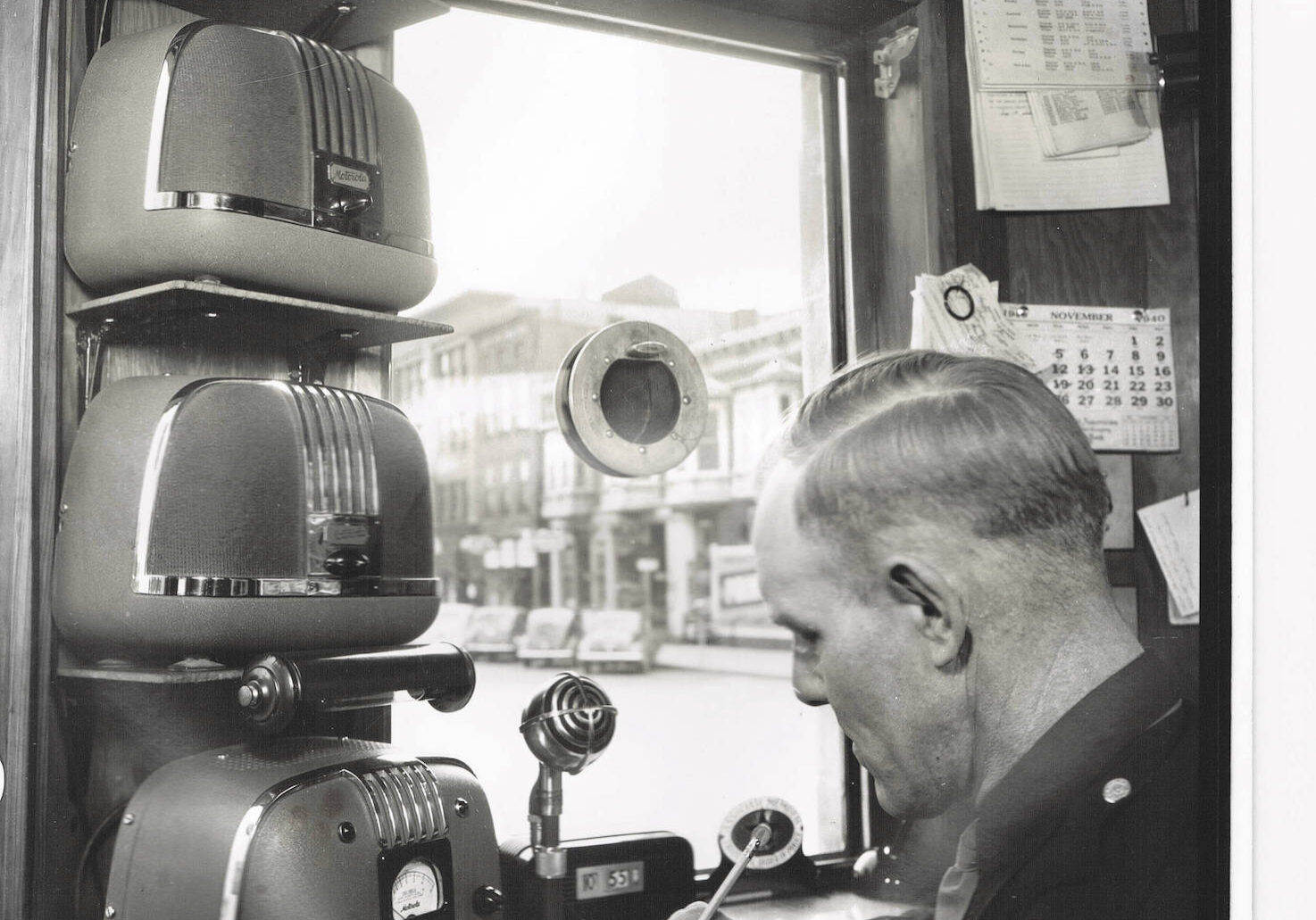
- Three workstations, each with a desk, drawer, telephone, police radio, and electric fan
- Originally electrically heated, later converted to natural gas
- A floor elevated four feet above sidewalk level, covered with durable rubber matting
- A crawl space beneath the floor housing heating, plumbing, and electrical systems
Despite its compact footprint, the booth functioned as a highly efficient command center.
Opening Day
The Goshen Police Booth officially went into service following a public “unveiling” ceremony on February 25, 1939. From that moment forward, it became a constant presence in downtown Goshen—lit, staffed, and operating around the clock.
How the Booth Functioned
When the booth became operational, all police telephone calls were routed directly to the control station. A special public telephone box was installed on the sidewalk so pedestrians could speak directly with the officer on duty—an early example of walk-up public safety access.
The booth was also integrated into the city’s emergency response system. A “teletalk” radio system connected the police booth and the fire station, allowing direct communication. When fire vehicles approached the Main and Lincoln intersection, a fire siren located at the booth was sounded to clear traffic.
Uses Over the Years
1939–1966
- Central police telephone center
- 24/7 police presence accessible to the public
- Location of fire siren for downtown traffic control
- Place to pay parking ticket fines
1967–1969
- Police radio transmitting headquarters and information center
- All calls for police assistance handled and dispatched from the booth
1969–1983
- Headquarters for the city’s parking meter enforcement staff
- Downtown visitor information center
1983–Present
- Transferred to the Goshen Historical Society
- Restored and preserved as a historic structure
- Officially re-dedicated in 1996 as a local landmark
Fact or Fiction: Separating Myth from History
FICTION — The booth was built to protect downtown banks from John Dillinger.
FACT — While Dillinger and other gangsters dominated headlines during the 1930s, Goshen experienced no such criminal activity. Dillinger was killed by the FBI in 1934—more than four years before construction began. The booth’s location and visibility did provide reassurance and deterrence, but it was not built in response to any specific threat.
FICTION — Tunnels connected the booth to banks, restrooms, or the courthouse.
FACT — Beneath the booth is only a crawl space containing utilities. No tunnels exist or ever did.
FICTION — The turret slots and window portals were for machine guns.
FACT — These openings were strictly for ventilation. There is no record of gunfire involving the booth at any time in its history.
A Symbol of Public Access and Trust
Perhaps the most remarkable aspect of the Goshen Police Booth is not its bulletproof glass or limestone walls, but what it represented: constant availability. For decades, an officer was on duty 24 hours a day, seven days a week, visible and approachable in the heart of downtown. In an era before 911 systems, this small structure served as Goshen’s lifeline.
Visiting the Police Booth Today
The Goshen Police Booth is open for public viewing during First Friday celebrations, typically from 5:00 to 8:00 p.m. Additional viewings may be scheduled by contacting the Goshen Historical Society at 574-975-0033.
For more stories like this—and to explore Goshen’s rich past—visit the Goshen Historical Society Museum in downtown Goshen.